9
Open-source Flash quiz maker
Posted by Betsy on February 27, 2009 in OpenSource | ∞
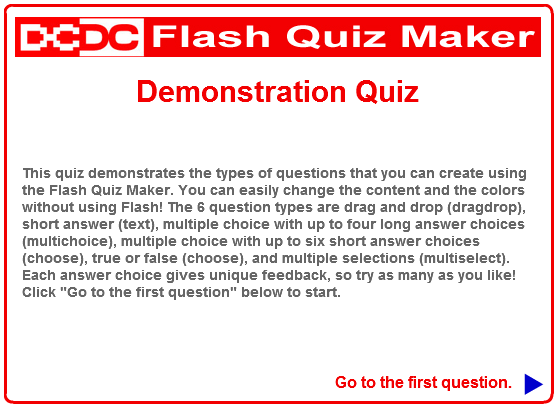
Click on the screenshot to check out an example quiz. You'll need the latest Flash player to see it.
Over the past several months, I’ve been lucky enough to be able to devote part of my working hours to learning to use Adobe Flash (CS4). Because I was a complete beginner, I worked through some basic Lynda.com tutorials about Flash and ActionScript 3.0 before striking out on my own. I set the following four goals for my output.
- Reproduce the functionality of the quiz template that came with older (CS 3) versions of Flash. This template allows you to make drag-and-drop, multiple-choice (single- and multiple-answer), short-answer (text input), and true-or-false questions.
- Improve upon the pedagogical value of the functionality by allowing more individualized feedback. For example, if the user chose the wrong answer in a multiple choice question, I wanted to be able to give feedback that explained why that answer was wrong. My inspiration for this came from the Hot Potatoes suite.
- Make the application accessible to instructors. This means that instructors shouldn’t need to know how to use Flash or even own a copy of Adobe Flash to be able to create a quiz and customize its appearance. I achieved this by linking all text, colors, and images to an XML file, which can be edited using any text editor.
- Make the application open and freely available. This was easy to accomplish thanks to the open-mindedness of my boss, Melissa, who is a fellow supporter of open source. The way she saw the situation, our group (the Distance Course Design & Consulting Group, aka DCDC) is funded by a federal grant – so the work that we produce should be shared with the taxpayers who ultimately fund the grant. (Yes! How true!) The quiz-maker application is published under the BSD, and the accompanying instructions are published under a Creative Commons license (BY/NC/SA).
I was able to accomplish all four of these goals! So, here is the DCDC Flash Quiz Maker as a .zip file. The file includes instructions on how to use it, which I hope are clear. Please comment below on how the application and the instructions could be improved! Or email me, or send me a tweet.
Some caveats:
- I envision this as an application to create teaching/learning tools, rather than assessing knowledge. That is why a range of individualized feedback is possible. This individualized feedback means that answers are not necessarily 100% right or wrong. This fact, combined with controls that allow the user to try a given question an unlimited number of times and freely move back and forth among the questions, means that a final score would be meaningless. So, no score can be recorded or reported to the user or anyone else.
- Bugs are guaranteed! I tested this, of course, and everything seems to work fine for me. But this is my first attempt at programming, and I probably didn’t anticipate what YOU are about to do with it. Please let me know about the problems you run into so that I can fix them. Or even better, send me a new version that includes the fixes and improvements you’ve made. That’s one of the great things about open source, right?
![Reblog this post [with Zemanta]](http://img.zemanta.com/reblog_e.png?x-id=0108838c-9a3c-48da-9af4-1b1a65f95514)

9 Comments
Betsy,
Well done! That this is your first attempt at programming and you were able to include the XML flexibility, that’s quite impressive. But most of all, I want to commend you on making this open source and available to others. The one thing that drives me nuts about the elearning development community is that no one shares anything. It’s almost impossible to find any good elearning course examples on the web for free, let alone flash source like this for interactions.
Sincerely,
mark
http://www.elearninglive.com
Thanks so much, Mark! I learned a lot that went into the drag-and-drop part from your tutorial (http://elearninglive.com/wordpress/tutorials/tutorial-simple-drag-and-drop-learning-interaction-using-actionscript-30/), so I consider you one of my teachers.
Congratulations for your fantastic elearning tool, i think Mark is righ when he said “…The one thing that drives me nuts about the elearning development community is that no one shares anything…”. But i just have a question: is any way to get a file whit the answer of each test?
Thanks and i hope to receive your observation :)
Martin Cortes
Thanks for your comment, Martin. Unfortunately, there is no way to get the answers with the tool as I’ve written it. That’s a more difficult problem to solve, but I hope that someone will work on it–and send a link back to me with the improved source.
Hi Betsy,
That’s not bad for a first attempt. It would be nice if you added some images to it and animation to it. You would be able to engage more user interaction that way. Saying that your actionscript proficiency is definately better than mine. Well done :)
Hi Betsy,
Is there any possibility of making the .fla file available in CS3 format? I have CS3 and apparently it can only open .fla files from CS4 if they have been saved to be compatible with CS3.
I searched a lot but i found this one to fit my requirement. It’s simple and that’s what makes me use most of the apps. Its free so i should not be asking more, it would be a great contribution to the Open Source Community if this did not required flash editor; would it be too difficult to port this into an application where users can simply create questions and create the final rendering in .fla or .swf
anyways, thank you for this article and the package, i was surprised you have included instructions as well in in .odt format (love the open office; can’t affford the rich guys’ game (Mr. Bill and his Office; hope their ripping off stops with open office in many levels)
Once more time, for those who are not into flash, would it be too hard for you to make this an APP itself ? That would be awesome. Because a lot of users still don’t know how to use .xml files etc, which is what drives the main app of yours.
Many thanks for giving something useful to the mass.
Cheers!
Are you still interested in tools to help instructors to put content into quizzes and video games?
Take a look at http://edulu.tm.com.mx
I’m combining javascript games with PHP and MySQL to make things easy for both teachers and kids.
Maybe I can incorporate Flash too.
Thank you very much Betsy!